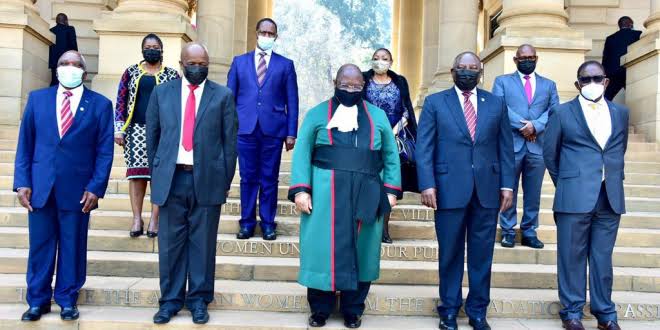
There was an air that the President of the Republic of South Africa should revive his misfiring cabinet by shaking things up at the very top. Subsequent to July 2021 riots, mummers soon gathered momentum about eminent changes in highest levels of government. The shoddy handling of the disputed “insurrection” is the final straw that broke the camel’s back. At last, SA has its first ever cabinet reshuffle under Ramaphosa’s watch.
Sunday | August 8, 2021
As a show of force, South Africa President Cyril Ramaphosa refreshed his cabinet to resolve bottlenecks and improve efficiency at the upper echelons of government.
The reshuffling of cabinet, the first under Ramaphosa’s regime, comes after a spate of a week-long riots, looting and arson that erupted in KwaZulu-Natal and Gauteng provinces in July.
The violence unleashed on these major areas of the country went on with little or no response from the state. The Ramaphosa government received an avalanche of attacks for its tardiness and indifference. Under-guarded shopping malls, warehouses, factories, vehicles were under siege with no end in sight.
Eventually, the blame was laid squarely on the government’s intelligence apparatus for failing to gather and anticipate the perilous events of the winter month. At the time, the country was placed on level 4 for Covid-19 restrictions that saw many people confined to their habitats with provincial travel prohibited.
It took local communities and taxi associations to reign in the tyranny of unrests that gripped and terrorised the country into historical chaos since the dawn of democracy in 1994. Then the poorly capacitated SA police buckled under a barrage of wanton destruction of property. The rise and activism of the citizenry emboldened them.
Insurrection, no insurrection
Very late in the dying embers of burnt property, the government sluggishly released the military on the affected areas.
Even then, there were contradictory optics on what the country was actually experiencing and went through. Meanwhile President Ramaphosa styled it as a form of “insurrection” with a “tribal” tinge, Defense Minister Nosiviwe Mapisa-Nqakula said what was engulfing parts of the country were not a form of insurrection.
Little wonder among the top guns shown the exit door is the Minister of Defense and Military Veterans Mapisa-Nqakula
On the other hand, Ayanda Dlodlo, the Minister of State Security, responsible for intelligence gathering intimated that information was relayed to the police, Bheki Cele, the Police Minister, denounced such remarks of receiving intelligence. Cele said his office never saw an intelligence report revolving around plots about throwing the country into turmoil.
This is yet another red flag in the Ramaphosa cabinet that shows gaps in its coordination efforts.
With these swaths of gaping holes at the highest level of the government, it became evident that the security cluster was caught off guard by the acts of brazen plundering, violence and vandalism. A point Ramaphosa later considered.
It would seem that this event eventuated into a watershed moment for The President to wield his axe and fashion massive changes to his cabinet. Therefore, the “reconfiguration” of the government structure at the very top came as no surprise.
These changes were expected and were in the boil for some time. The trigger of the widespread protests ensued after the highest court in the land – the Constitutional Court – sentenced former SA President Jacob Zuma for 15 months in jail for contempt. The early days of his incarceration led to protracted violence in two big provinces in the country.
The effects of changes President Cyril Ramaphosa ringed to reclaim and stamp his authority, will manifest in months to come. They will indicate whether he has stabilized the state of affairs in the country in the intervening short period. And much later, an improved service delivery trajectory accompanied by confidence in the economy for potential investments.
New-look cabinet
With this reshuffling of the deck chairs, Ramaphosa promised the nation by saying that:
“we are working to ensure peace and stability in the wake of the recent outbreak of violence and destruction in parts of the country… mobilising all available resources and capabilities to rebuild our economy and provide relief to those most vulnerable.”
Appointments of new Ministers are as follows:
- The Presidency: Mr Mondli Gungubele
- Communications and Digital Technologies: Ms Khumbudzo Ntshavheni
- Defence and Military Veterans: Ms Thandi Modise
- Finance: Mr Enoch Godongwana
- Health: Mr Joe Phaahla
- Human Settlements: Ms Mmamoloko Kubayi
- Public Service and Administration: Ms Ayanda Dlodlo
- Small Business Development: Ms Stella Ndabeni-Abrahams
- Tourism: Ms Lindiwe Sisulu
- Water and Sanitation: Mr Senzo Mchunu
And the incoming Deputy Ministers to a bloated cabinet are:
- The Presidency: Ms Pinky Kekana will come in as a second Deputy Minister
- Agriculture, Rural Development and Land Reform: Ms Zoleka Capa
- Communications and Digital Technologies: Mr Philly Mapulane
- Cooperative Governance and Traditional Affairs: Ms Thembi Nkadimeng
- Health: Dr Sibongiseni Dhlomo
- Mineral Resources and Energy: Dr Nobuhle Nkabane
- Public Service and Administration: Dr Chana Pilane-Majake
- Small Business Development: Mr Sdumo Dlamini
- Transport: Ms Sindisiwe Chikunga
- Water and Sanitation: Ms Dikeledi Magadzi
- Mr Zizi Kodwa: Deputy Minister in the Presidency responsible for State Security.
Noteworthy, Health Minister Dr. Zweli Mkhize and Finance Minister Tito Mboweni requested to stand-down from their positions.
There is no denying, the destructive pandemonium that broke out in recent weeks have eroded trust and confidence in the ability of the state to govern a highly polarised nation.
According to the International Monetary Fund (IMF), South Africa is still one of the most unequivocal societies in the world.
The President has one of the unenviable jobs to date and the spotlight is on him to prevail.