Wednesday | November 25, 2020
The extraordinary Argentinian football legend Diego Maradona died upon suffering a heart attack. He was 60 years old.
It is widely reported that Maradona was recuperating from a brain surgery undergone in November due to a blood clot.
As a token of honouring the supremely talented hero, the President of Argentina Alberto Fernandez declared a national mourning for three days.
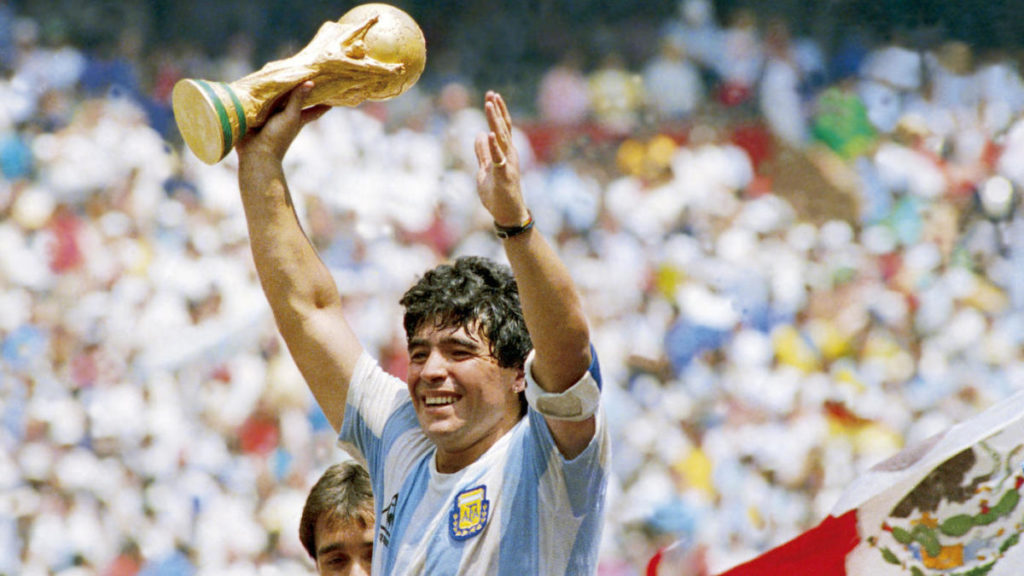
Maradona captained and spearheaded the Argentina attack that heralded them to the 1986 world-cup winning team after some breathtaking performances in Mexico. Quite remarkably, he scored a superb goal that would later be recognized as the goal of the century. For nostalgia’s sake, Maradona weaved his way through almost the entire wobbly England squad with sublime athletism and wonder. He was truly gifted. Football was in his brains.
Before that splendid goal, the dimunitive Maradona sprung high to his limits to contest against the English goalkeeper for a lopped ball and helped it [the ball] with his hand into the back of the net. The goal stood. It is generally known in football circles as the infamous “hand of God” goal.
In the fullness of time, they beat England 2-1 in the quarter-final draw. Their semifinal was pretty much pedestrian. They had Belgium to dispose: 2-0. The ultimate test came in the final against West Germany. Maradona delivered Argentina to a 3-2 victory to earn the most coveted prize in this world-wonder showpiece that comes every four years.
Four years later, Argentina emerged as the runner up behind West Germany. The table had turned. That loss induced a teary struggle from the world’s super star of that era. The Germans were crowned the 1990 FIFA World Cup champions.
The shock was not over for Maradona and his compatriots. In 1994, he was sent home for failing a drug test in the tournament that had made him a world renowned star. Yet again, the dream start was snuffed out and hopes snatched away. It was all over. The 1994 edition of the global football competition, which was won by Italy, proceeded in the United States of America without the magical Maradona.
Maradona’s meteoric rise
He made his presence felt in the 1970s where his was playing for the development sides in country of his birth, Argentina. Boca Juniors acquired his services in 1980 to 1982. He was a household name then.
Without a doubt, clubs all over the world clamored and hunkered for Bona Diego Maradona’s signature.
The first stop in his European adventure begun on 1982 Spain with FC Barcelona. He stay for two for two season before he sought new suitors.
It was Italy where he made heavy waves. He signed for Napoli in 1984 and put them on the map outright. It is here where he traded most of his exploits and won accolades. He left in 1991.
Among his forages, he made a stop at Seville FC in 1992/93, just for a season. And he vamoosed.
To honour the land that unleashed his exceptional talent to the world, he returned home. He donned the Boca Juniors jersey as a swansong to the game he gave so much, before he hung his boots aged 37. By the time Maradona decided to bid his farewells, he had given his all to the beautiful game.
Man about town
Maradona never shied away from the limelight he helped eluminates stadiums, pubs and homes will profound joy. Maradona was an extrovert too. As Patrick Snell, CNN Sports Anchor, put it: Diego Maradona was the man of the people; he had an infectious misdemeanor.
He would be spotted mingling gayly in major football tournaments, including the world cups. In all these jolls, stories about drugs and alcohol abuse swelled. This is the sad aspect about a very talented and highly respected I on in the sport fraternity. At times, this sordid part of Maradona has its own oscillating episodes of getting booked into hospitals.
While Maradona tried to live life to the fullest, he was still passionate about football. He felt his legacy would not be enough without giving tmore than audience to the game. He pined for more. An authoritative position in the upper stakes of the beckon. Firstly, the urge and, secondly, the call was untenable and undeniable. He obliged.
Last shot
He became Argentina manager in 2008. His assignment was a steep incline to qualify for the 2010 FIFA World Cup in South Africa.
Controversy followed him. Upon his announcement of his trusted troops to lay a claim to the highest honour in football, he left out some key national team players in his first and the last coaching job as a national team manager. The mega event, of course, was in 2010 to be staged for the very first time in Africa.
The game begun in South Africa, the host country then. Having failed to progress beyond the quarterfinals thereof, Maradona was sacked. He failed to lift, this time as a coach, the trophy he won over two decades ago as a player. Thus, the fairy tale was cut short.
Tributes poured from all corners of the world and cut across many fields. Among the notable names are The Great Pele, Pep Guardiola, Sachen Tendulkar – the cricket legend.
The final respects shared in different platforms by different personalities epitomize the true mark of the phenomenal genius that Diego Maradona was. His pulling power and effect on and affect about and, indeed, magnanimity for the game.
Few will argue against this talisman [Maradona] from south America that he carried Argentina on his shoulders to the ultimate 1986 world-cup victory.
It is this timeless souvenir that sets Diego Maradona apart from the generation after him and/or the current crop – mainly Lionel Messi (Argentina) and Christian Ronaldo (Portugal).