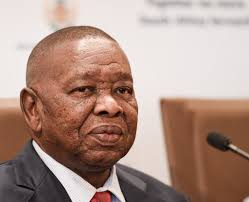
South Africa – On Saturday, the Minister of Department of Higher Education, Science and Innovation Blade Nzimande cleared the path and gave a go ahead for the resumption of tertiary education and vocational training before President Cyril Ramaphosa’s national address on Sunday. At a time when the number of coronavirus infections are on the rise in South Africa (SA), the education sector braces itself for a gradual reopening. Although institutions of learning are going to allow few students through their gates of knowledge and training for contact learning, apprehension and trepidation lingers in the wintery air.
SA President Cyril Ramaphosa will address the nation on Sunday night, May 24, 2020.
The country awaits with magnetic anticipation what will be the new developments from the Union Buildings frontier. Yet, nothing can escape the speculation that, among other issues, which regions in the country will enjoy further downgrades of the economic restraining measures. Will there be more economic relief stimulus in his speech? The citizens wonder.
Meanwhile experts are pointing out that the economy has endured enough regression and cannot bear an indefinite pounding. For this reason and more, SA has reaped the benefits of the nationwide socio-economic restrictions that began March 26, 2020. There is no value derived from a continuous pushback against the reignition of the engines in different sectors of the economy, they proffer.
Tertiary education
On Friday May 23, Minister Nzimande reiterated that institutions of higher learning that meet the required Covid-19 safety standards will reopen for face-to-face learning in June.
Further, he said students who can not carry on with remote learning, their institutions must categorize them and plan for the implementation of their return.
In this regard, the DHET’s May 23 statement stated that:
“All public universities have developed detailed strategies for remote multi-modal teaching and learning during the period of the current lockdown, for implementation as from beginning of June as per our previous commitments.”
As far as staff members and students with co-morbidities (including people over 60 years of age), the department urges them to stay at home in accordance with the “risk-adjusted strategy” announced by President Cyril Ramaphosa. Again, it reassured affected employees that their job responsibilities will be rearranged. The department went as far as adding any disease that reduces immunity and compromises the health of persons that it must also be prioritized.
There will be daily screening for every student, staff member and person who enters campuses. According to the department, institutions which are not yet prepared for Covid-19 safety measures may not open their doors yet.
Poor ICT and data costs
DHET Deputy Minister Buti Manamela stated that online learning as the only mode being practiced now is not sufficient. Instead, he said, a multidisciplinary approach that integrates different styles must be considered. “No student should be left behind,” Manamela stressed.
The poor and lack of telecommunications infrastructure in many parts of the country have resulted in mixed reactions and lead to consternation. The lower investments made in information and communication technologies (ICT) have come back to haunt the industry and society when it matters the most.
Broadband for the internet service providers (ISP), poor network strength [connectivity] and the exorbitant cost of data for students and/or consumers have been a recurring frustration.
Connectivity as evidenced by weak video interviews and conferences across different media has even highlighted the dire straits of reliance on ill-equipped online systems in SA.
However, to address the issue of cost and access to online learning content, DHET advanced that:
“Zero rating means that access to institutional websites will be free, although some of the embedded content like YouTube and videos will be charged for.”
Universities around the country have distributed laptops and complementary devices for enabling students to receive education services from the comforts of their homes.
DHET said only final-year students were allowed as of May 1 on level 4 of the lockdown. Further, it signaled that under level 3, a mere 33% students population will be welcomed back on campuses. The determination of who should return is on the purview of each institution in the country.
On level 2 of the lockdown, “a maximum of 66%” will make their way to various campuses with level 1 ushering 100% return of all students, the DHET statement said.
TVET schools or colleges
On May 25, Principals and Supply Chain Managers will report back to work, while Middle Managers and Lecturers will return on June 1 and (June) 8, the Department announced during a press briefing on Saturday May 23.
The department has also provided guidance and direction the Technical and Vocational Education and Training (TVET) colleges will follow upon returning to schooling through the phased-in model.
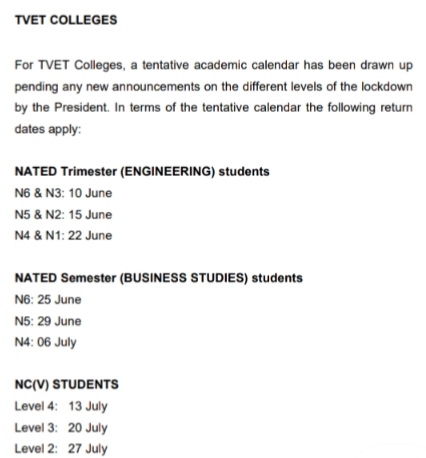
The reopening of TVET colleges will depend on the stage of the lockdown in that province or region. However, the department indicated that a “campus-based approach” will guide the resumption of their functioning.
To this end, the DHET said that:
“Campuses located in districts that remain in lockdown level 4 will remain closed and students will be supported using multi-modal remote learning approaches. Each of these colleges will therefore develop a detailed remote learning support plan and share it with students as well as post it on the college website.”
Bilateral agreement with Madagascar
Dr Nzimande made mention that the Department of Higher Education, Science and Innovation has a bilateral agreement with the Madagascar Science and Technology branch to collaborate on exploring indigenous knowledge and medicine in the wake of the Covid-19 pandemic.
Madagascar has launched what it calls a “cure” for coronavirus. The World Health Organization (WHO) has reiterated that there is no cure for the deadly virus to date. It is urging research and trials to lead the search for a vaccine. Conversely, a number of African countries have placed orders to secure a “Covid-Organics drink” from the African island.
Adam Vaughan posted May 15 on NewScientist that:
“The World Health Organization (WHO) has said that a herbal drink promoted by the president of Madagascar as a cure for covid-19 should be tested to see if it is effective.”
According to this article based on France 24 publication, the purported prevention and remedy drink “is reportedly made from Artemisia annua (sweet wormwood) and herbs”.
Reopening of schools and more sectors on the cards
In South Africa, attention is focused on what Ramaphosa will announce when he talks to the nation tonight. Several provinces have raised their hands to show readiness to be considered along with areas to be included in the level 3 lockdown migration.
Although level 4 was seen as semi-level 5, the highest and extreme version of restricted economic activities, level 3 allows more flexible return of many industries albeit on limited bases.
Among these, is the education sector involving, in the main, the youth of the country. Of major concern to every stakeholder is whether the 2020 academic year will be finished on schedule.
So far, the coronavirus unprecedented disruptions have cast suffocating heavy clouds of doubt over its completion. Commentators indicate that the reworked new-calendar changes may stretch it to end by early next year.
For its part, DHET has committed to seeing it completed as planned without denying every student the opportunity to learn under these trying times.
On May 23, South Africa’s confirmed cases stood at 21, 343 and 407 deaths and 10, 104 recovered from the life-threatening scourge.