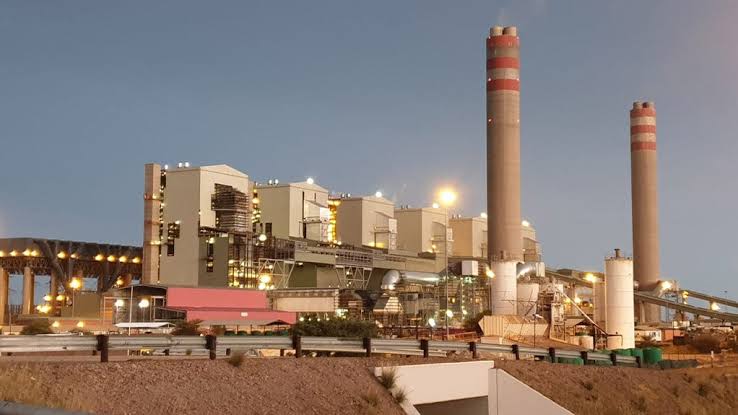
“[L]oad-shedding is a controlled way to make sure the national power grid remains stable.” ~ Eskom
Marred by corruption, embroiled in scandals, and mired by nerve-wrecking debts, Eskom is jeopardizing the prospects of South African “dreams” which President Cyril Ramaphosa delivered in his 2019 state of the nation address. Rolling power blackouts – the so-called “load-shedding” in South Africa – have plunged the country into unprecedented haunting darkness. Will there be light at the end of the Eskom tunnel? So far, so gloomy. The implementation of “stage 6” [the equivalent of 6,000 megawatts of power off the grid] on Monday, has left Ramaphosa numb with “surprise and shock”. At the receiving end of these dramatic intermittent power supplies are innocent tax-paying citizens whose livelihoods are in the doldrums. Better still, reliable energy provision is the bedrock of the economy whilst Eskom is on life support with blinking, if haphazard power-lights.
It has been nine days since the state’s power utility company Eskom implemented power cuts across South Africa. Even so, there is no solid assurance of it being lifted completely. The reality is that the country has been plunged into uncharted territory.
Much of the power outages were triggered in a week of heavy downpours across the country. The escalating power cuts clocked stage 6, a record high on Monday Dec. 9 where a ⅓ [equal to 8 hours] of the day consumers or users in SA were left without electricity supply. The dread for further escalations was not far off. However, on Tuesday Dec. 10, Eskom downgraded power outages to the familiar high: stage 4.
Economics of electricity supply
Reporting for The Times, Unathi Nkanjeni quoted Eskom delineating load-shedding as “a controlled way to make sure the national power grid remains stable.”
Electric power availability is a fundamental energy source in the country. Without it, economic activity slows down a great deal. Even worse, its unpredictable supply undermines all economic growth efforts. Industries, organisations and households suffer immeasurably. It scares away potential investments. Energy is an enabler a country can not afford to have in adequate levels to ignite the economy and compete globally.
During these dark hours of power outages, business and services were enormously disrupted. Dumped in screaming darkness, some service providers shut their doors. Whereas others operated intermittently as and when power was restored periodically, others resorted to expensive to run generators.
Households power consumption ground to a halt. Worsening the prospects of growth in an already depressed economy.
The situation was so dire the President of the Republic of SA Cyril Ramaphosa had to cut his trip to Egypt short. He returned home to comfort the displaced and assure investors. Nevertheless, his return was marked by a mixed bag of complex explanations, adorned with contradictions. He was as hopeless as many of the citizens looking for clarity in a period of uncertainty and doom.
Gung-ho on a fishing expedition, Ramaphosa lumped the blame on “saboteurs”. To his credit, upon his return the power blackouts were rolled back to stage 4 which before stage 6’s event was viewed as the highest level of power cuts.
Inclement weather was also another reason factored in. Fuel-filling stations could not get their stocks on time and taps ran dry. Motorists had to drive from one station to the next to fill up their cars with elusive fuel.
As the hardest hit communities shouted for help due floods, some (electricity) power stations were also flooded. Adversely affected households sought refuge in community halls and church premises in Mamelodi, east of Pretoria, and Ekurhuleni, east of Johannesburg.
In the Centurion area, a relatively affluent suburb in Pretoria, helicopters were brought in to rescue stranded individuals. Cars were flipped and flown by dense water, property battered and informal structures mangled, nothing was spared in the wake of the tormenting floods.
Strawman theories and fallacies
Eskom Chief Operating Officer (COO) Jan Oberholzer and the President apologized for the power outages. Oberholzer said that the “sabotage” was done by an individual/s who had intimate knowledge of the by power utility’s system.
Qama Qukula posted Oberholzer’s explanation about stage 6 being “undesirable but it’s not a crisis” on Cape Talk 567 saying:
“Monday’s stage 6 announcement was a once-off scenario created by the perfect storm of conditions, including wet coal stockpiles and broken generating units… generating units continue to break down as a result of long-overdue maintenance and planned refurbishment at coal-fired plants.”
Labour Unions decried Ramaphosa’s explanation as a redherring. They said he was “misled” to believe in widespread load-shedding was the work of a Sabotaged unit. Since the Tuesday Dec. 11 farfetched explanations, stage 4 and stage 2 have been alternating deliberately.
And there are technical challenges and aging power facilities, compounded by the mismanagement of the power utility. The centrality of the politics embroiled are well documented.
The Eskom March 2019 reports on the technical performance of the utility showed that:
“The energy availability factor of the generating plant decreased considerably from 78% in 2018 to 70% in the current year. The decrease was attributable to an increase in both planned and unplanned maintenance of coal-fired plant compared to the prior year.”
Eskom, just like other state-owned enterprises (SOEs) such as the SABC (South African Broadcasting Corporation), SAA (South Africa Airways, to list only two, is on its wobbly knees.
The irony about Eskom is that it is a giant and ungainly monopoly. Not only does it supply power to the domestic market, but also exports to neighbouring states. Yet, its books are in the red year in and year out. It is a discouragingly failed government entity.
Culture of none-payment
It gets ridiculous. Some of the arms of government are owing Eskom. Not to mention Soweto – a famous township in the south of Johannesburg rich in history premised on the struggle for democracy in SA – bearing and home to arguably over 50% of none-playing residents.
An article that appeared on BUSINESSTECH last month stated that:
“Municipalities and individual users owed Eskom over R36.5 billion as at 30 June 2019. Eskom’s long‐term debt is currently at R441 billion (as at March 2019), up from R255 billion in 2014. Over the next five years, the Department of Public Enterprises anticipates interest payments of approximately R148 billion and debt repayments of R180 billion.”
For this reason, a jaw-dropping R18, 909 billion may be owed by Sowetans.
“Boycotting payment for services had a place in apartheid, South Africa. It was an effective tool to mobilise communities against an unjust system,” BusinessTech cited Ramaphosa.
Although this revenue robs Eskom of mounds of cash inflows, its annual increases are not sufficient to plug the sinking hole. As a matter of fact, the annual above inflation tariff hikes by Eskom are primarily aimed at that but they wind up increasing the cost living for ordinary citizens in majority.
In actual fact, if Eskom had its way it would double the already back-breaking tariff hikes. The energy regulator, National Energy Regulation of South Africa (NERSA), is the main barrier. It maintains a reasonable balance between the power supplier and users.
Beside Eskom having been among the public entities used as a vehicle to line the pockets of a select politically connected, it is riddled with redundant staff as reported widely in the media. Government keeps reiterating that Eskom is too big to fail, hence the bailouts gushed out unabated. To what end?
Potpourri of divergent remedies
To firm its unequivocal support of the SOEs, the Minister of Finance Tito Mboweni has roped in a so-called “Chief Restructuring Officer” to oversee its astounding money being pumped in to kick Eskom back into life.
The Minister of Public Enterprises Pravin Gordhan has been drumming the separation of Eskom timeously. The unbundling of Eskom will be actuated in the coming months henceforth.
On the question of the “stage 6 load-shedding” being an “crisis” or not posed by Samkelo Maseko of eNCA, the private media powerhouse, all the minister could say was it is a “manageable crisis”. Indeed, the level of ambiguous explanations from the government has reached tipping point.
The opposition Democratic Alliance (DA) interim leader John Steenhuisen did not mince his words weighing in the simmering crisis: Eskom is not approaching collapse, it has collapsed. Needless to emphasize, DA supports the idea of energy mix through competition.
However, the National Union of Metalworkers’ (NUM) General Secretary Irvin Jim has vowed to rally other unions – Cosatu (Confederation of South African Trade Unions) and Saftu (South African Federation of Trade Unions) – to join forces early next year to demonstrate against the possible privatization of the state utility.
Leadership challenges
Compounding its tormenting troubles, Eskom has been badly managed for years. No single individual among its big shot decisions have not been held liable bar a few contract termination here and standing downs there. None whatsoever!
It is indisputable that the Executive Board of Eskom is unstable. The company loses Chief Executive Officers (CEOs) the same way it switches off electric energy. Sikhonathi Mantshantsha of the Daily Maverick wrote:
“None of them have lasted more than three years, with Brian Dames having had the longest tenure between 2010 and 2013. Over the past 12 years Eskom has been the place where executive reputations go to die.”
Although it will have a new CEO, Nampak’s Andre de Ruyter, next year (January 2020), it has not had one in many months since Phakamani Hadebe threw a towel in May 2019. He cited poor health and red tape among the reasons that typified his stepping down a year later after taking the job in May 2018.
With the CEO’s office in abeyance, its current board chairman Jabu Mabuza is acting at this intervening moment.
The Eskom ambiance is so populated and polarized such that even the most competent of personnel misfire or are straitjacketed by its politics to falter. The decision or the eventuality that lead to escalating power outages to “Stage 6” signify a near total collapse of the power utility.
Debt, solutions, and privatization
In March, it presented its annual financial report. To its credit, it posted a R2.5 billion increase on revenue which was eroded by costs, ending with a net loss after tax of R20.7 billion from R2.3 billion in the previous financial year (2018). That operating income seems like a drop in the ocean on the R18. 4 billion decline, a result of increases in interest on loan/s and depreciation.
Loans financing was down to R31.5 billion in 2019 compared to R45.4 in 2018. Although Eskom’s workforce declined through “natural attrition” – not replacing some retired and staff who left or passed on – its “[e]mployee benefit expenses increased by R3.8 billion from R29.5 billion in 2018 to R33.3 billion this year,” marking a hike of 12.9%, it’s annual report indicated.
Eskom’s 2019 revenue was undermined by lower sales in the local market attributed to slow economic growth level. Furthermore, sales on exports also declined as a result of import substitution – increased efforts by neighbouring or SADEC (Southern African Development Community) countries to produce their own energy. Eskom’s debts stomach-churning (R440 billion) debt.
Another reason for production decline posted by Eskom on its annual report indicated that:
“Production from Eskom generation sources decreased from 2018 because of… an increase in production from IPPs (Independent Power Producers) … by 18% from 9 584GWh in 2018 to 11 344GWh in 2019.”
Speaking to eNCA in the week, Minister of Mineral Resource and Energy Gwede Mantashe denounced the promotion of IPPs at the expense of other options. Adding that they are an expensive alternative. He advanced the integrated approach with” gas” gaining more resounding mentions from him.
It does not inspire much hope for the future. Talks of privatization are being mooted all over. And they are not new by any standard. There is the unbundling of it into three independent divisions: generation, transmission and distribution. Its success is anticipated with bated breath.
Alongside privatization, there is a ground swell of concurrence on diversifying power supply. Therefore, a mix of fossil fuels with renewable energy, fracking, gas and other affordable options. The exorbitantly expensive nuclear power alternative is off the table as it provides a long-term solution, especially for baseload energy.
Meanwhile, mine houses and big industry players are hoping the government will relax legislation to allow enough generation of their own energy sources. Currently, they have to hedge their bets on Eskom improvement notwithstanding plummeting production stockpiles.
Whether the government will open up the market for this diversity and more players, thus opening up the market for competition, it will only be believed once it sees the light of day. In the meantime, the strife to keep the lights on by Eskom is still very much a sad daily reality.