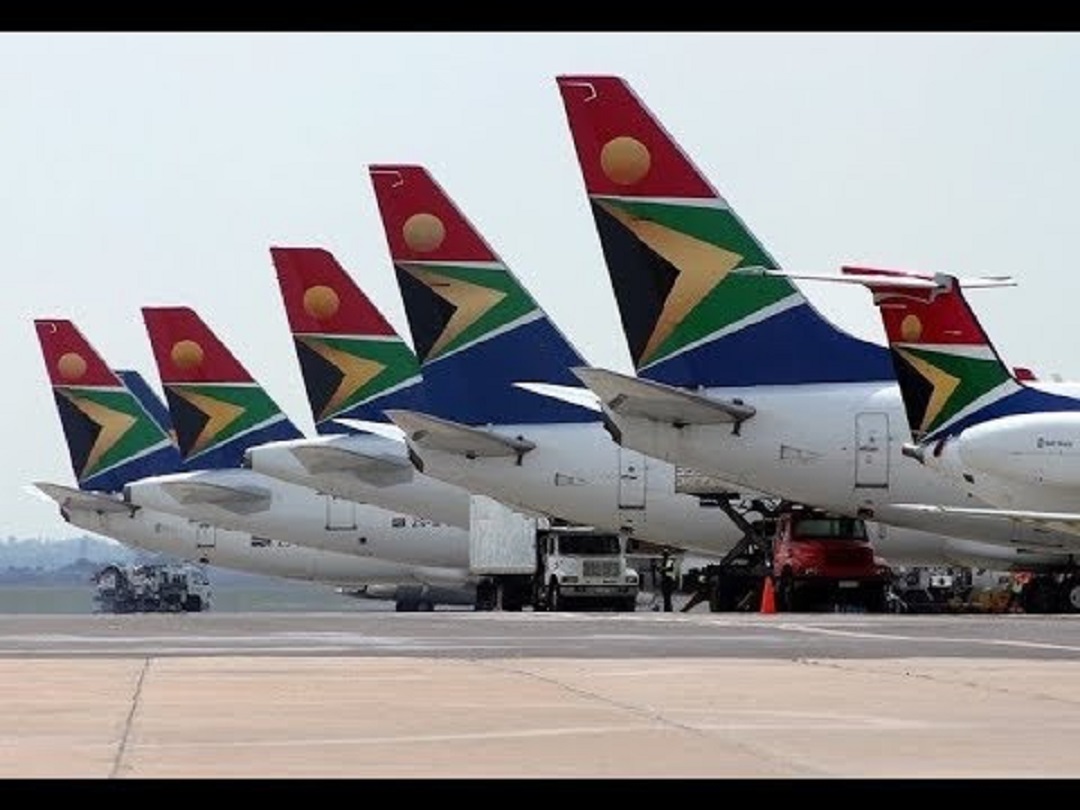
As axasperated workers plod on industrial action and fickle management twiddle thumbs while South African Airways (SAA) burns, the state airline is tanking.
The bankrupt government-owned SAA has been forced to ground some flights on Friday Nov. 15 following industrial action by its employees upon a deadlock on salary hikes, job security and other work-related matters.
“The cancellations only affect flights operated by SAA. All flights operated on our partner airlines Mango, SA Express, Airlink and all codeshare partners will not be affected,” SAA communicated on Wednesday on its website.
On Monday Nov. 11, SAA announced the restructuring of the airline which may place “944 [out ‘of its 5,149’ staff] jobs in jeopardy, a wage increase of 8% that was denied, and a demand to have certain services be insourced immediately,” reported Fin24.
SAA posted on its website Nov. 13 to keep its clients abreast about flights disruptions that:
“South African Airways (SAA) regrets to advise all customers that we been served with notification by the South African Airways Cabin Crew Association (SACAA) and the National Union of Metalworkers of South Africa (NUMSA) of their intention to embark on a strike effective Friday, 15 November 2019.”
Up to this point, the workers on the picket lines involve SACAA and NUMSA affiliated members. South African Transport and Allied Workers Union (SATAWU) – one of the major labour movements in the country – is not part of the strike. However, on eNCA it said it supports the employees “morally” to show “solidarity” in their quest for better wages and fair labour rights.
Fundamentally, SACAA and NUMSA demand 8% salary increase whereas SAA is prepared to settle for merely 5.9%. The financially distressed national carrier has stuck to its guns. Speaking through its spokesperson Tladi Tladi on Talk Radio 702 today, SAA said it is hamstrung by “affordability and sustainability” hardships to table the current offer.
Tladi Tladi further alluded that the failure to settle on the current offer led the airline to halt some aircrafts from flying until Sunday for international trips and Monday for domestic flights. The SAA’s advisory notice emphasized reimbursement for passengers seeking such [refunds] and rescheduling during this November until the 30th. The new flights or trips will be reorganized with new date/s allocation extended to October 2020 based on clients’ requests and preferences.
Compounding the situation is the restructuring strategy SAA has opted for which may see countless jobs shed. Neither it is a new strategy by any stretch of imagination nor has it any guarantees of success. It is one out of the many fruitless and costly turnaround plans that the beleaguered state-owned airline has tried and failed dismally in recent memory.
It is due to these permutations, among other issues, that employer-employee have been back-and-forth bargaining behind closed doors for a fair deal. A thorn on the sensitive flesh of labour unions are potential layoffs.
There is general consensus broadly that SAA has been badly mismanaged without holding incumbent managers accountable. A fact that lends credence and legitimate rallying support from the public at large. Moreover, there is a public outcry about the mooted retrenchments which might exacerbate unemployment rate [29.1%] already high by any standard and, further escalate the levels of jobs scarcity in the economy.
Not unexpectedly, labour unions and their backers have squarely apportioned blame on SAA management for the long standing dire financial paralysis at the state airline. Without qualms, the airline itself admits that it has gone belly-up and restructuring is the way to go. The paramount bane for the stalemate. According to Business Tech, unions have sworn “total shutdown” should SAA not yield on their demands and obstinately persists on its retrenchment drive. Definitely, the battle lines are boldly drawn.
While cynics unapologetically point to the long noses poked by politicians as the elementary problem within SAA business, analysts vehemently keep warning that the airline has long reached moribund stage. Thus, it needs to be partially or wholly privatized; a bold signal to let it fold. In its current state, SAA depends on government grants to keep it afloat. It is simply not profitable at the moment, much less sustainable.
What with the frequent changes of floundering executive management at South African Airways and routinely tracking back to the state with a begging bowl for bailouts!
In 2018, Engineering News (Oct. 31) and EWN (Nov. 1) cited Economist Professor Jannie Rossouw, who at the time was head of the Fiscal Cliff Study Group, told Parliament’s finance committees about SAA that:
“Give it away, it will not fly, we are tired of a vanity project. I have heard in this committee that politicians are proud to see SAA aeroplanes parked at international airports. Park the things there and wash them! It’s cheaper than to try and fly them.”
Rossouw’s advise came at the back of the 2018 Medium Term Budget Policy Statement (MTBPS) where SAA was handed a R5 billion bump on a silver platter by Treasury to ameliorate its financial troubles.
On a diametrically unrelated case, in October, SAA recalled some aeroplanes due to procedural matters concerning its fleet maintenance red-flagged by the industry regulator, i.e. the South African Civil Aviation Authority of South Africa (SACAA).
Currently, as angry workers plod on industrial action in anticipation for impartial sitting and management twiddle thumbs while SAA burns, the airline is tanking; with it hemorrhaging millions of rand daily which may take time to recoup while suffering unavoidable irreparable reputational damage.
On Saturday Nov. 16, South African Airways return to the negotiation table for possible resolution talks with SACAA and NUMSA representing employees. As workers enter into their second day of strike, EWN reported that SAA loss amounts to “R52m a day” due to the ongoing strike.
Updated Friday Nov. 22, 2019
SACAA and NUMSA finally secured their 8% salary increase facilitated by Commission of Conciliation, Mediation and Arbitration (CCMA). SAA and employees accepted the settlement; bringing to an end a protracted strike against the state-owned airline.