Bleak economic outlook in the midst of government declining tax revenue and rising debt is a cococktail of problems in South Africa.
The Finance Minister Tito Mboweni tabled the Medium Term Budget Policy Statement (MTBPS) Wednesday October 30, 2019 to a sombre reception.
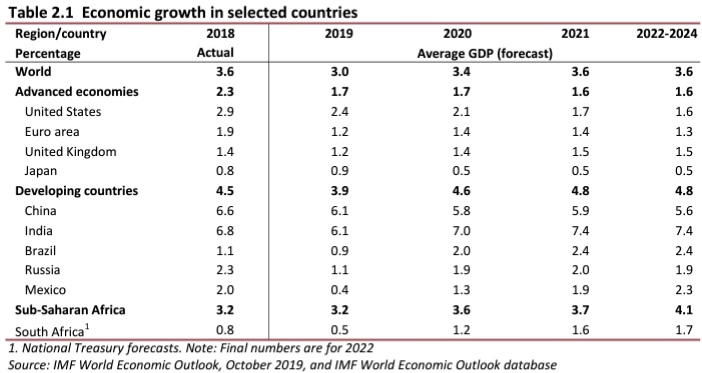
Critical in it was the annual update of the 2019 economic outlook projected to a lower than estimated 1.5% revised down to a choking 0.5% and 1.2% in 2020 growth rates. And a year after that, a 0.4 percentage point bump (on 1.2%) in 2021, and a slight hike to 1.7% in 2022-2024 projections.
Times are hard. The uncertainty of it all makes the future too ghastly to phantom and embrace. Competitiveness will be a vital element in a cutthroat world that will separate winners from losers in the economic stakes.
The usual suspects of the deadening economic picturesque are: global economic slowdown, policy uncertainty, poor domestic economy climate, low investment, poor education and energy shortages are instrumental to the drags economic stagnation, inflicting hardships SA is undergoing and obviously yet to likely face.
While the mid-term budget announcement forecasts tax collection shortfall of R52.5 billion for the financial year 2019/2020 period, government expenditure is increasing. As a result, the revised 2019 budget – R1 422.2 trillion – indicates a R1 369.7 trillion. Declining corporate tax owing to diminishing profits and rising unemployment contribute to the anticipated lower than expected revenue collection.
The government is spending more than its income, said Mboweni. Therefore, the consolidated fiscal framework which incorporates national and provincial governments, public entities and social security agencies projections are briefly summarised below:
- Consolidated revenue collection for the period 2019/2020 reflected R1 537.8 trillion which constitute 29.5% of Gross Domestic Product (GDP) while expenditure shows R1 844.1 trillion, i.e. 35.4% of GDP.
- Posting a deficit of 5.9% in the current financial period and increases to 6.5% in 2020/2021.
- The steep is arrested in 2021/2022 as Treasury expect it to decrease to 6.2% and further down to 5.9% in 2022/2023 – see the table accompanying the story.
Inflationary pressures on GDP stands at 4.8% and rising to 4.9% in 2020-2021, downwards to 4.8% in 2022. Consumer Price Index (CPI) likely to leapfrog from 4.3% currently to 4.9% in 2020, decreasing to 4.8% in 2021 and stabilizing at the same rate in 2022.
Gross debt-to-GDP rose to 56.7% in 2018/2019 and accelerating to R60.8% in 2019/2020 next year, and the uptick trajectory continues to 64.9% in 2020/2021. By 2022/2023, government debt would have shop up to a breath-taking 71.3 per cent.
Central to the deficit is the increasing demand and government guarantees for funding required to rescue state-owned enterprises (SOEs) mainly Eskom, the power utility.
- Cut benefits of ministerial Handbook” – cabinet ministers allowance is capped at R800, 000 per annum and all cabinet members will fly economy class for domestic trips;
- Reduce litigation or claims;
- Simplify procurement processes, and
- Additional allocations to combat corruption and wasteful expenditures: SAA Receiver of Revenue R1 billion and National Prosecuting Authority R1.3 billion.
Consequently, government is embarking on austerity measures on cherry-picked areas. Among other measures to meet fiscal target in the medium-term, the MTBPS envisaged to generate over R150 billion include:
- reducing the wage bill which accounts for 46% of the 2019/2020 expenditure;
- disposing off non-core assets; and
- considering additional taxation streams.
The National Treasury will finalise these interventions in 2020 during the main budget.
Potential growth industries are in energy – speeding up licenses for small-scale independent power suppliers, tourism, telecoms and construction linked with modernity among others.
Whatever steps the government takes, it is evident that the patient is in a critical state. Its treatment is long overdue. In tightening the belt on the fiscus, corruption and wasteful expenditures must be uprooted.
Assistance accorded to law enforcement agencies and regulatory bodies to follow the paper trail and recover what it can. Direct expenditures in areas that will reboot the economy and whet the appetite for massive domestic and foreigner investments.