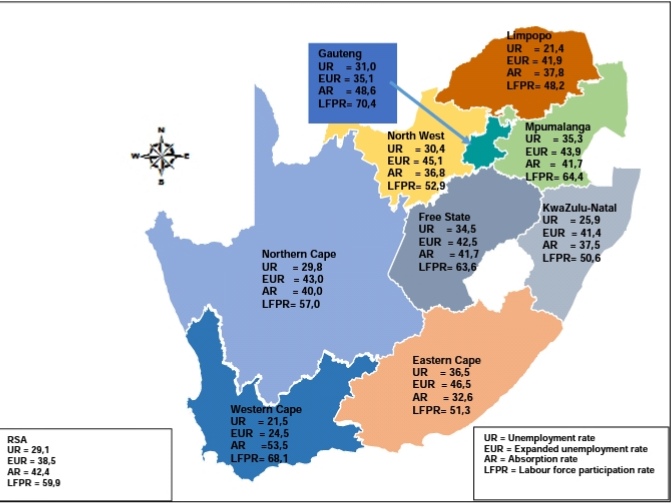
As the Medium Term Budget Policy Statement (MTBPS) by Finance Minister looms large, job numbers are out and they are underwhelming. Compounding the odds is an International Monetary Fund (IMF) July report which reflected sluggish global economic growth rate and downward revision of South Africa’s prospects. Failing to arrest the slide and beat the odds, the 1994 painstaking secured democratic economy is sagging into a catastrophic chasm.
The Department of Statistics South Africa (Stats SA) has published the “2019 Quarterly Labour Force Survey” of the 3rd quarter (Q3) on Wednesday October 29.
In it, the official unemployment rate has increased to 29.1% in Q3 from 29% in Q2, marking a slight 0.1 percentage point bump.
The expanded definition of unemployment, which includes people who are despondent to look for jobs stands at 38.5%. And the stubborn percentages keep on climbing high. There is no let up on the horizon whatsoever.
By any standard, these fresh staggering numbers are powder kegs in a society boosting an estimated population size of “58,78 million”, according to Stats SA’s 2019 mid-year publication. A segment of roughly 6.7 million in SA is jobless and the mid-term budget is expected to spell, in part, how this demoralizing statistic can be whittled down.
The World Bank forecasts on SA adjusted on Oct. 10, 2019 shows that:
“The South African economy grew by 1.3% in 2017 and 0.8% in 2018… projects 2019 growth at 1.3%, accelerating to 1.7% in 2020.”
On Wednesday October 30, the Finance Minister Tito Mboweni will deliver the medium-term budget speech. A mid-year barometer of how the country has fared in real economic terms in relation to the annual fiscal policy tabled earlier in the year. It’s prism on adjusting government progress and/or lack thereof; to a degree, a hint on tax reliefs or more pains in eroding citizens pockets or firms’ yields.
This is going to be one of the toughest MTBPS for Mboweni yet. Moneyweb recently published a possible deficit on revenue collection to the tune of R50-98bn:
“By the end of August, the South African Revenue Service (Sars) had collected 37% of the total tax budget for the 2019/2020 year. By the same point last year, it had reached 39%. This suggests that the organisation is going to have a hard time reaching its tax collection targets.“
Experts believe the minister will shed light on ways to stimulate economic activity. Views abound on the potential partial sale of the government energy supplier Eskom to the private sector to offset its technical and financial woes. Given recent commitments state bailouts to keep the public utility afloat and unbundling it into three divisions, privatisation is off limits at the moment but very much on the Treasury’s agenda atop mahagony table.
The unbundling of Eskom into generation, transmission and distribution as independent subsidiaries is envisaged as a panacea to its longstanding hodgepodge of troubles.
The recent R56-billion rescue package Eskom received from government, and by all indications there will be more to come (its way), economic analyst and Wits academic Lumkile Mondi cited on Daily Maverick calls it “throwing good money after bad” due to the derth of “competency needs” require to return the state-owned power supplier to profitability and sustainability.
IMF’s July report posted that “global growth is forecast at 3.2 percent in 2019, picking up to 3.5 percent in 2020 (0.1 percentage pointower than in the April WEO projections for both years).“
A take of South Africa economic outlook the IMF’s updated July 2019 projections indicated a decline from 1.3% to 0.7% in the 3rd quarter – a 0.5% lesser than its April With Q4 revised to 1.0% this year, the 2020 review showed a decrease of 0.4% from 1.5 to 1.1% citing energy challenges and prevalent industrial strikes in the country.
Globally, the ongoing trade war between the United States around recurring tariff hikes on imports and China countering in equal measure as well as uncertainty around United Kingdom’s (known as “Brexit”) position in Europe (the Eurozone) were among major factors stifling investment, the (IMF) report showed.
As if the IMF downbeat projections were not enough, the unemployment rate has reached a record high in 11 years and this calls for sound fruit-bearing economic policies from the (SA) government.
These developments around unpredictable global policy shifts and the latest unemployment figures, notwithstanding the onslaught loosened by the emergent 4th Industrial Revolution (4IR) on jobshedding, will undoubtedly have an influence on the budget speech on Wednesday.