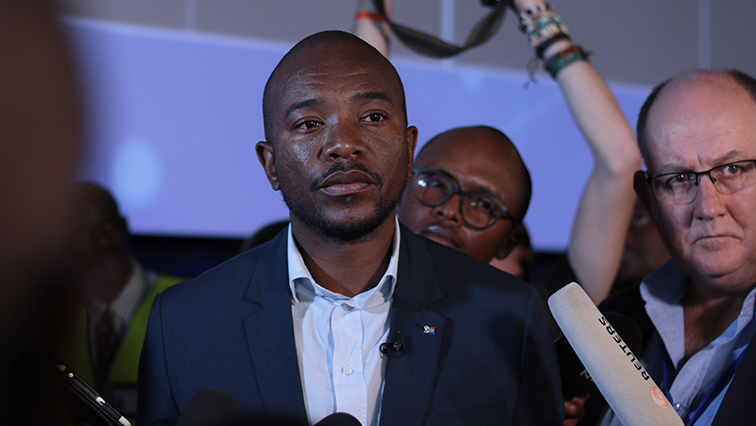
Democratic Alliance (DA) leader Mmusi Maimane has resigned Wednesday Oct. 23, 2019 but remains head of the party in parliament. Maimane became the elected leader of DA in 2015 succeeding former Western Cape Premier Helen Zille and got re-elected last year (2018). He leaves with three (3) years left of his 4-year term as the party leader. His departure is linked to the five (5) National Assembly seats DA lost earlier this year in the general elections. However, Freedom Front Plus gained six (6) seats and the Good Party two (2) seats. In three days, DA has lost two incredible black leaders any political party worth its salt would hunker down for and wish to have in its leadership chambers: one young, charismatic and brimming with potential, and the other, assertive, pragmatic and entrepreneurial. Maimane was not alone on jumping the DA disoriented ship. Party chair Antol Trollip’s withdrawal enunciates the fact that there is leadership implosion in the party.
Spotting a floral-Madiba-like shirt, tempered with brown and light beige, randomized with pinkish speckles, Mmusi Maimane bellowed during Herman Mashaba’s resignation statement at a media conference: “You [Herman Mashaba] are my hero!”
From that moment on, as it was in the lead up to the hair-raising [Mashaba’s] final kick and, indeed, since the outcome of the May general elections, speculation soared about Maimane’s imminent departure following Mashaba’s fall from mayoral leadership on Monday.
Today, Maimane mastered the courage to bite the bullet and confront his political home to give notice that he was dropping his political authority he held since 2015. In December, Maimane said he will abandon his parliamentary position also as DA head. How will this work beggars believe because Maimane said the party does not share his vision.
Along with Maimane at the same venue, former Mandela Bay mayor and party chairperson Athol Trollip peeped through and submitted his resignation forthwith. “There is a time to come and there is a time to go,” Trollip said on retiring his “party chair” position in the Democratic Alliance.
The resignations of both Maimane and Trollip have left the party with a leadership vacuum. The DA is currently leaderless. It’s constitution states that when a party leader vacates, the party chairperson fills in the position on interim bases. As it stands, the FedEx Council has resolved to meet under Zille’s hawkish guard to get legal advice on how better to traverse these troubled waters.
Back in winter (this year), daggers were frozen and Maimane survived the chop after a DA-convened committee post-2019-general elections recommended that he should step down after the party’s poor results at the polls.
During that choppy period, Trollip unequivocally stood by Maimane’s side and vouched for him to stay put as party leader after the explosively contested national general elections.
From that time onwards, Mmusi Maimane appeared more like “a broken man, presiding over a broken” party, to lift a leaf from his fateful description of the former SA President Jacob Zuma back in 2015.
His resignation comes four (4) days after the election of Helen Zille as the new DA Federal chair. She is the matriarch, boss lady and the brains behind a modern-day party capturer. It is known that upon her vengeful return to the party she was going to spit voracious fires to vanquish her detractors to bite the dust.
The gods behind the DA capture stressed and placed the party’s downfall at the polls directly at the doorstep of its leadership. Stopping short of saying that Maimane was instrumental, they said he presided over the first slump since democracy in 2019 general elections: DA electoral support declined to 20.77% (equivalent to 84 parliamentary seats) from 22.3% [89 seats] in 2014. And he should pack his luggage and go.
To put things into perspective. The governing African National Congress (ANC) dropped from 62% [249 seats] in 2014 to 57.50% [230 seats] in 2019.
DA is the official opposition in South Africa in the National Assembly (NA) or parliament. NA has 400 seats in total.
The fact is: the two major parties in SA suffered at the recent national elections, this year, though much worse for the majority party, signifies wide-ranging problems hard to cetralise on an individual.
The compelling reasons behind ANC’s drop in electoral support are well-known but, can the DA’s (negligible, arguably) fall be ascribed to Maimane entirely?
Though the DA will be tight-lipped to admit, it has fundamentally summed up and nailed its diminished 2019 electoral support on its party leader: Mmusi Maimane. That is how it comes across.
However, the man of the cloth steered DA to coalition governments in Tshwane and Johannesburg (in leadership limbo right now) municipalities in 2016 local elections. Moreover, the party reduced ANC majority government in Mandela Bay municipality among his notable achievements of his 5-year tenure.
On its cyber repository, DA published after the local elections in 2016: “Over 30 municipalities are now DA-led and 16 million South Africans currently experience some form of DA governance.” What changed?
The tumultuous relinquishing of the reigns by Mashaba on Monday has definitely rattled the blue cage. Democratic Alliance’s Federal Council (DA FedEx) held a meeting earlier today concerning the recent resignation of its councillor and Johannesburg mayor Herman Mashaba on Monday Oct. 21, 2019. By all intents and purposes, it tried to its wits’ ends to stage-managed Maimane’s and Trollip’s dual plung.
The next day, however, the wobbly DA will rise up and dust itself up to take stock of a self-induced bloodbath and delude itself that nothing of that sort never happens again.
Mashaba was accompanied by Maimane during his resignation announcement at a media briefing. At the end of Mashaba’s bombshell, Maimane held Mashaba’s hand aloft, praising his leadership, he rumbled: “[T]oday is a difficult day for the people of Johannesburg,” citing Oct. 21, 2019 MagRush.co.za article.
Mashaba’s standing down was triggered by the election of Helen Zille as the new FedEx chair over the past weekend. The former Joburg mayor followed up on his word that he would not serve under a DA party usurped by “right-wing elements”.
Maimane is a pastor who joined the DA in 2009 and was elected party’s national spokesperson in 2011. He did not shed light on his future post-December – if he gets there – when he will finally renounce his parliamentary job under DA banner.
Maimane’s ascendancy in the DA was propped up by Helen Zille. Their honeymoon waned when Zille overstepped her mark and begun publicising divisive and colonial tinged messages on Twitter, the trendy social media platform. Still, the vehement ideological battles behind closed doors were simmering but this one (of tweets) took the brawl to the public’s messy streets.
It is also believed that Maimane backed Athol Trollip – one of Zille’s fierce rivals – on Sunday’s FedEx chair rate race. As it turned out, he hedged his bets on a wrong or more crudely, a losing horse.
In DA’s brutal tug-of-war, Mashaba’s Oct. 21 and Maimane’s Oct. 23 resignations will go down in the annals of political history as the October Two who obstinately resisted tokenism.
These twin-historical events are seismic setbacks for DA that managed to grow its black electoral support in the past few years with its roots deeply imbued in the dominant-white administration, financial upkeep and electorate.
Zille’s somersault to DA control may be a pyrhic victory for the disgruntled elites and conservetive caste. The veil of secrecy and their calculated next moves will fall off as the capturers come out to communicate the new regime’s strategies. Foremost in DA’s minds will be to mop up the mess it engineered for the cookie did not crumble as planned. Similarly, domino effect looms ever so large. Therefore, damage limitations may become enormous and expensive, not only in the short-run but in the long-run.
DA’s latest jabs in its black leaders underscore its thirst for minority political hegemony. A regression for it undermines its previous victorious crusades on luring the blacks to administrative positions as well as the rank and file terraces in a rational and concealiatory way. The reputational damage to the party will take long to repair; of course, only if that is in their agenda. But DA has shown lack of appreciation in the transformative strides SA has been meticulously crafting since the dawn of an inclusive democratic state.
Professor Mcebi Ntletyana was even more robust in his critique. DA risks becoming a regional party based in the Western Cape because it has failed to create policies that resonates and actionable to the majority of South Africans, he said.
Whatever the strategy the DA has in its hollow chambers, it better not backfire. Reportedly, the conservatives within dumped DA for Freedom Front Plus (FF+) in the recent [May 2019] national and provincial elections.
Interestingly, FF+ grew by over 100% in the recent elections: from yielding 1.00% in 2014 to gaining 2.38% in 2019, i.e. a meager 4 seats five years ago to a tremendous 10 seats currently.
The hounding and harassment of Ex-Cape Town mayor Patricia de Lille was not insignificant. She went away to form the “Good Party” which took and chipped away constituency [0.40% amounting to two (2) parliamentary seats] from the DA, thereby catapulting itself into the National Assembly.
The inroads made by FF+ and the Good Party gaining an aggregate of eight (8) seats in parliament by fraying and exploiting DA incendiary differences. From this perspective, the DA slump is more pronounced by the herculean 2019 electoral showing of these two political parties although not conclusive.
For this reason, DA’s 2019 outcomes gravitated toward the retention of the black vote, even grown slightly. If this critique holds sway, how then are all the party’s flounderings are lumped on a 39-year-old five years at the helm of a political behemoth established in 1959 under the “Pregressive Party” (PP) band?
The PP metamorphosed in 1977 to become the “Progressive Federal Party” (PFP). The rebranding continued in 1989 where PFP transioned into the “Democratic Party” (DP) and, later, merged with the New National Party (NNP) and Federal Alliance (FA) to form and be known as DA – its current plaque in the SA political branding landscape.
Viewed from this backdrop, the Democratic Alliance is cutting off its nose to spite its face by its recent purges and pushback against black leaders.
Granted, Mashaba and Maimane are not the definitive gold standard of black leadership within the DA and quite broadly, in the country. Nevertheless, they should not be passed down as cannon fodder either. The manner in which they (both) vacated their positions and the history of the party to which they (both) served is what is in dispute.
The backlash by the conservatives may not have been a by-product of Maimane’s doing per se. Possibly, it may have arisen due to internal factional squabbles, divergent policy ideologies and the behaviour of some influential and financial backers inside and outside the party among an array of contentious issues.
Just like any person, Maimane is imperfect. And in all likelihood, he is susceptible to the foibles of our habitat. Moreover, he may have threaded on some irritable toes within the party by imposing his philosophy – i.e. “if you don’t see that I’m back, then you don’t see me”. This may have been cold comfort to nostalgic colonial lords; consequencially, interpreting him as having grown too big for his boots.
However, he is the national leader of the party. A substantial number of DA supporters resonates and may well sympathise with him during his dark hour of need. For this reason, DA may bleed support which cynics strongly disputes as nonexistent. What is indisputable though is that DA’s leadership at theot top echelons, already three well-known political heavy hitters have seen enough.
To show that Maimane’s days as DA leader were numbered, the party threw him under the bus when a donated Toyota Fortuner he was driving before the 2019 general elections surfaced. The Toyota Fortuner in question was donated to the party by the controversial former Steinhoff Chief Executive Officer Markus Jooste and availed for Maimane to use for electoral campaign purposes, the DA National spokesperson Solly Malatsi said in Maimane’s defense.
His other Achilles’ heel is that he does not have a Maimane-centric ideology people can identify him with at a drop of a hat. Even the hot-and-cold puffs he blew in the past did not fly within the SA’s tradional and whitish vanguard, much less in the broader society.
Political analysts like Prince Mashele, a research fellow at the Center for the Study of Governance Innovation at the University of Pretoria, said DA can expect an exodus of epic proportions. A DA electoral process designed to usher new leadership at Federal level purposed with injecting more energy is doing more harm than good.
Political parties in SA are their worst enemies. They seem to be commonly embedded with cancerous factionalism. DA is not an exception to the rule juging by its own internal terminal shambles unraveling at the slightest nudge.
Some (DA) members and voters in general may see Mashaba’s duck and Maimane’s tumble from grace as a dig in leaders who mirror who they are and pathfinders of a futuristic-cosmopolitan-African state at peace with its horrid past and liberty with its diversity.
That their stepping down should not be viewed as isolated and incidental but, well-orchestrated purges in some posh cocoons by the new hegemony, spearheaded by the wrecking-ball and new sheriff in town, Helen Zille and her clique. The message can not be more clearer: if you are a liberal tea-sipping liberal rubbing shoulders with poverty-sympathetic socialists, you will face ejection without warning.
In characterising DAsweeping changes, others have been bold by putting the party at its rightful place and pronounce: the old guard is back to cleanse the corridors of the “blue-train” party to its “puritan” exclusive club by reclaiming its former self.
Even though the sentiments around Mashaba are that he was a local leader, Johannesburg is an ebullient economic hub in Africa and the biggest municipality by population size in SA. Therefore, he is not a small fry by any conceivable scale. Having said that, Mmusi Maimane’s surrender is colossal due to its national reach.
In part, what has emerged on Monday and today is that DA is not prepared for transformation nor support policies geared towards a shared vision for an inclusive South Africa.
Bowing out in his unrepentant mode, Mashaba said on Monday: “It is not in my nature to wait for people to push me, I have lived my life in my own terms.” Today Maimane said: “Go chechela morago ga se go tshaba,” ke go tseya matla – a Sepedi expression which loosely translates into: To retreat is not fleeing, but to regroup or gather strength.
In the meantime, the weekend’s momentous changes may haunt the party immeasurably and further, its reverberating ripples may become catalytic in future elections and arcebic perspectives in the realm of race relations.
Are all these developments extraordinary and vigorous enough to redefine the SA’s political-pendulum swing? Well, that question hangs ever so high and distinctly open to divergent interpretations.