MagRush writer | September 6, 2019
To dusty earth. Death, the leveler. Even the hardest of men capitulates and fall eventually. The fragility of life humbles and renders all nature of souls infallible. Zimbabweans will surely remember how revered Robert Gabriel Mugabe was in his formative years ascending to higher office and shudder to ponder his last episode later. Now he is no more. An end without a ceremonial swan song under the stern and inviolable force of Zimbabwe soldiers who wanted him gone without a tussle.
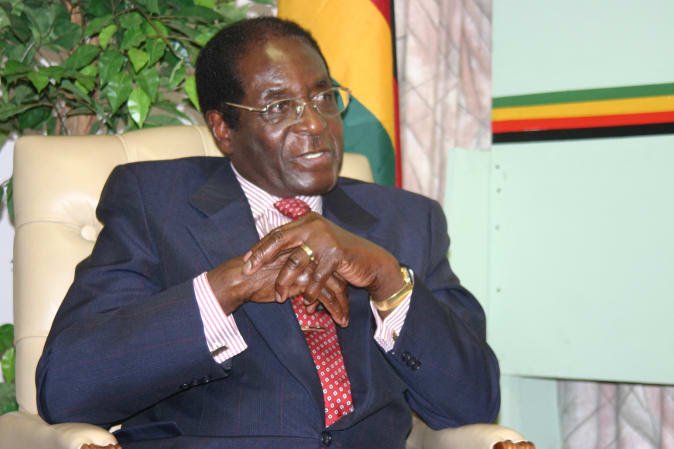
Former Zimbabwe President Robert Gabriel Mugabe died at a Singapore hospital at the age of 95 after a protracted illness. Condolences are pouring from all corners of the world.
The 2018 biography by History.com Editors shows that:
Robert Gabriel Mugabe was born February 21, 1924, in Katuma, a Jesuit mission station 50 miles west of the Southern Rhodesian capital. His father, Gabriel Matibili, was a carpenter from Nyasaland (later Malawi). His mother, Bona, belonged to the prominent Shona ethnic group. Mugabe graduated from Katuma’s St. Francis Xavier College in 1945. For the next 15 years he taught in Rhodesia and Ghana and pursued further education at Fort Hare University in South Africa. In Ghana he met and married his first wife, Sally Hayfron.
Mugabe’s first wife (Sally) died in 1992 after struggling with ill-health. “Sally was at the time suffering from renal complications,” a 2018 News24 article reads, “and was unable to bear children for the former president.” Robert Mugabe went on to marry his former secretary Grace Mugabe in 1996, four years after his deseased wife. At the time, Grace was 31 years old and Mugabe 72 when they officially got married. They had three children together.
BBC reported this morning that:
“He was imprisoned for more than a decade without trial after criticising the government of Rhodesia in 1964. In 1973, while still in prison, he was chosen as president of the Zimbabwe African National Union (Zanu), of which he was a founding member.”
Mugabe became the first Zimbabwe president post-colonial (British) rule after Ian Douglas Smith when the country gained independence in 1980. He would herald a new era that embraced everybody in Zimbabwe. His regime made school fashionable by introducing free education from primary to tertiary and availed health services to all citizens. This would become the demographic dividend of post-colonial “Southern Rhodesia” (as it was known then).
He was forced to resign in November 2017 after what manifested as a semi-coup d’état by the Zimbabwe military. Ghastly staring at impeachment, Mugabe finally fell on his sword after parliament passed a motion of no-confidence in him. In the 2008 Zimbabwe general elections Mugabe admitted he was ready to step aside after losing to his Rival, the late MDC (Movement for Demographic Change) President Morgan Tsvangarai, according to Reuters April 3, 2008 article citing a Business Day report. Zimbabwe military would have none of it. As a result a presidential run-off was concocted and Tsvangarai opted out. A deal would ultimately be brokered in 2008 that made Tsvangarai the Prime Minister Zimbabwe and Mugabe a ceremonial President. That arranged marriage of political convinience did not last. Tsvangarai filed divorce papers.
Trying his best to hold onto power, in the early 2000s, Robert Mugabe heartlessly commanded Zimbabweans to occupy farms predominantly under the guard of “whites”, political mayhem ensued and Zimbabwe collapsed into social instability and economic ruin. The country’s economic woes worsened when the international community unleashed a streak of sanctions. Hordes of Zimbabwe citizens emigrated to neighboring states to seek refuge and better life. The majority of the exodus of these (Zimbabwean) citizens live and work in South Africa.
In 2002, Mugabe was at his menacing best when took to the podium at “Johannesburg earth summit to denounce Tony Blair, telling the British leader: “‘Keep your England and’ [l]et me keep my Zimbabwe,” The Guardian posted. He was an utterly firm and unrepentant president.
Another blight in Mugabe’s regime came in the 1980s where rampant genocide commonly known as “Gugurahundi” was committed by government assisted by the UK according to reports. Botswana-based INK Centre for Investigative Journalism discovered what it calls “the mystery dossier” of how Gugurahundi was conducted and/or executed:
“While many reports about the killings existed in the public domain, this particular one had been a closely guarded secret due to allegations that the international community was complicit… somewhere in the dusty libraries of universities, or government institutions, was a report with details of extrajudicial killings of the Ndebele-speaking people by a Zimbabwean army acting on the command of the recently-deposed president Robert Mugabe.
‘“Gukurahundi”’ loosely translates from the Shona language (one of the main languages spoken in Zimbabwe, alongside English and Ndebele) to mean “the early rain that washes away the chaff.” The killings bearing that name left as many as 20,000 dead between 1983 and 1987. Mugabe had deployed the North Korean-trained Fifth Brigade soldiers in the Matebeleland and Midlands areas of Zimbabwe in the early 1980s to quell dissident threats, an operation that resulted in the well-documented atrocities.”
This report is corroborated by the Mail&Guardian April 30, 2019 piece: “A Zimbabwean organisation has started exhuming the remains of victims of a government massacre during former president Robert Mugabe’s rule, which claimed some 20 000 lives. Mugabe’s regime deployed a North Korean-trained crack military unit to fight alleged dissidents in parts of the Matabeleland and Midlands provinces in the 1980s, according to rights groups. The targets were mainly from the Ndebele ethnic group, perceived as backing a rival to Mugabe, who is from the majority Shona group. Mugabe did not publicly apologise for the crackdown.”
Robert Mugabe was at his wit’s end in the twilight of his nearly three decades of his tenure when he allowed his influencial wife to dictate government programmes and courting with takeover the presidential reigns. In 2017, Mugabe was succeeded to the presidential throne by his deputy, the 77-year-old Emmerson Mnangagwa – with the help of the military. Mnangagwa would later be democratically elected into office in 2018 after a fierce showdown with MDC in the main.
Writing on his Twitter account, President Mnangagwa tweeted this morning that Mugabe “was an icon of the liberation, a pan-Africanist who dedicated his life to the emancipation and empowerment of his people. His contribution to the history of our nation and continent will never be forgotten. May his soul rest in eternal peace.” Speaking to eNCA, Mnangagwa spokesperson Gorge Charamba said although Robert Mugabe was well-respected, he overstayed his welcome as Zimbabwe president.
The current MDC Nelson Chamisa speaking to Dan Moyane on eNCA said of the Iron fist deseased Ex-president, although Mugabe contributed a great deal to the Independence of Zimbabwe, he also left millions of citizens in misery.
Mugabe’s life casts a typical tale of a glorious struggle of the stelwart meshed with a gory present he ushered in his latter days and uncertain bleak future visited on the people of Zimbabwe. For them, and the rest of Africa and world, which memory will stick or sting the most is open for various interpretations.