MagRush writer | September 4, 2019
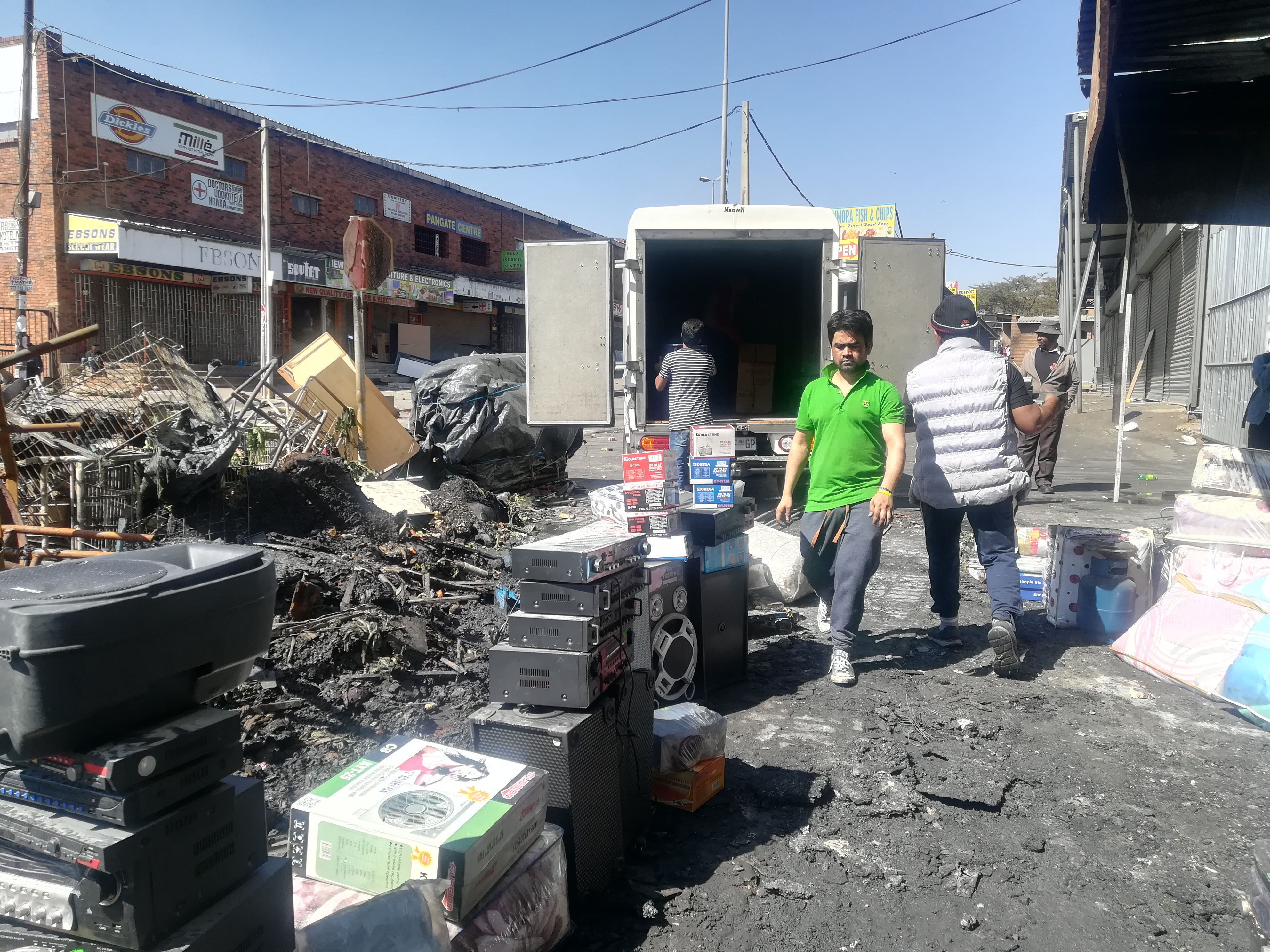
Today – Two bodies were found charred in a block of burnt buildings in Alexander, Johannesburg, reported Linda Mnisi on Newz Room Africa. This follows looted Malls in Alexander and Katlehong after assailants blockaded roads to prevent access to the two areas.
Yesterday the Minister of Police Bheki Cele confirmed that five people have been killed since the start of violent demonstrates in South Africa two weeks ago.
“I don’t think I can stay here anymore. It is not safe and this happens every year,” said a Bangladeshi shop owner in Alexander who was interviewed by GrownUp yesterday.
It is absolutely alarming how much damage has been done in cities and townships across the country while the government is fast asleep. To an extent that the country is spellbound by these heinous crimes points to how much the state knows or does not know about issues affecting ordinary citizens on the ground. Everybody must be worried!
How come some of the vicious attacks on major cities occurred without being noticed, notwithstanding the availability of coordinated efforts by perpetrators known in advance by the general public? Where is the costly missing link on the government’s side?
Seemingly government is dismally falling short to preempting and proactively stopping most of the brazen and gruesome diabolic acts committed in the name of widespread protests across the expanse of the country. The Police have largely been reactive. All that has been happening is damage minimization in the aftermath of innumerable loses of property, people’s businesses and lives.
Appearing on Newz Room Africa yesterday Johannesburg mayor Herman Mashaba had this to say about the prevalent mass attacks:
The SAPS (South African Police Service) and JMPD (Johannesburg Metro Police Department) have no capacity to deal with the protests. There is a need to bring in the army. There is a national department of intelligence, Home Affairs and Police but they seem ill-informed about circulating communication ordinary citizens are exposed to day after day.
However, Cele warned against invoking the services of the South African National Defense Force (SANDF) to quell civil unrests and disobedience. Furthermore, he said should the SANDF be brought in, “it will look like a Sunday picnic with dead bodies.” The country is nowhere near that, the Police Minister reiterated.
Fundamentally, the authorities have largely been reactionary when violence escalates, in some cases the response has been very tardy and tentative. Cele said there is “intelligence” and government has increased police deployments to curb violence. Potential attacks have been foiled in many areas, he emphasized.
Violence and destruction of property is on overdrive mainly in Gauteng Province. The tyranny of the looting and arson stranglehold on society is continuing unabated without an end in sight. More worrying is the spike of criminality masquerading under the guise of protests. Certainly the taxi drivers who instigated what was coined as a noble course to fight drug lords never imagined that the wave of their initiative could be overtaken by opportunistic rogue barbarians and usurped for catastrophic outcomes witnessed daily.
On Monday, 2 September, a man found himself in harm’s way and died of firearm wounds in one of the streets in Hillbrow, Johannesburg; later, a body of another person, a woman, was discovered laying dead as well.
On the same day, building structures, mainly shacks, were burnt down in Marabastad, Pretoria. Likewise, a car dealership was burnt down to ashes in Turffontein, Johannesburg. Sadly, the shopkeeper told Linda Mnisi that the business premises selling second-hand cars was not insured because it did not meet the (insurance) requirements. Still, no structure is supposed to be reduced to rumbles or ashes.
In Coronationville, Johannesburg, two people were shot and killed, caught in the crossfire during a protest gathering. The Police confirmed the arrest of a Pakistani national who is held in custody. All these goring developments are either occurring concurrently or back-to-back in SA.
University of Cape Town (UCT) was shut down by students and classes disrupted yesterday on the heels of a fellow student, Uyinene Mrwetyana, who was allegedly raped and killed. The suspect was arrested and has since pleaded guilty to murdering the student. It is believed a house belonging to the accused was set alight yesterday. The Mrwetyana case has sparked Rae and heightened awareness movements around the country about the macabre of femicide countrywide.
Peaceful demonstrations have been led from parliament to the World Economic Forum (WEF) underway in Cape Town. Today there was a planned march to handover a petition to the Vice Chancellor of UCT. GroundUp reported clashes between the police and protesting students where stun grenades, pepper spray and water cannons were unleashed to disperse throngs of students during the march. President Cyril Ramaphosa has already voiced his outrage about femicide: “gender-based violence is a national crisis,” and widespread riots in the country saying that everyone is welcomed in the country.
Yesterday in Kempton Park CBD, West Street, a brawl broke out between Nigerian nationals and SA citizens wherein the police had to intervene to defuse the standoff.
Naturally, whoever is under fire is likely to fight back when cornered. There are heightened security concerns in South Africa currently that have led to Zambia canceling its friendly match against Bafana Bafana (SA senior men’s national football team). There is bound to be a pushback everywhere, especially against people under siege, whether those people are SA residents or foreign nationals.
In 2008, SA was gripped by widespread xenophobic attacks beamed across the world in various media platforms. People better hope government does not wake up way too late when the descent will be equal to catching a falling sharp bayonet.