MagRush writer | August 30, 2019
Hardly a month since the eruption of civil strike in the City of Tshwane by employees on wild revolts for a wage hike, Pretoria was gutted by yet another public disruption on Wednesday. “Rogue” elements crept in and goods were stolen en masse. Then buildings in poor state set on fire. The city ground to a halt, affecting businesses and services across major parts of the nerve center.
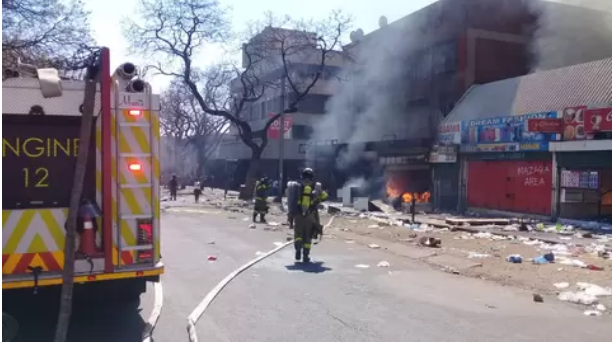
A section of rundown buildings were set alight on Wednesday in Pretoria central. The incident broke out after taxi drivers went on a rampage protesting against the death of a fellow member who was apparently shot and killed in cold blood by a foreign national on Tuesday. 702 Talk Radio reported that “[o]fficials confirm that at least five people” have been apprehended for cross-questioning.
According to reports, the slain taxi driver accosted a drug peddler who it’s alleged was selling drugs to hapless vagrants. An altercation ensued and gunshots were fired. The taxi driver dropped dead on the spot. Intermittent chaos broke out soon after the incident.
Taxi drivers were on a crusade to “forcefully remove drug dealers off the streets, 702 Talk Radio said. It is understood the deceased driver wanted to conduct a “civil arrest” against the alleged drug-smuggler. Unbeknown to him, he was confronted by an unrepentant soul who smoked his last breath out of the face of the earth. Thus, meeting death prematurely.
Abner Tsebe, chairperson of Gauteng Taxi Association, said on 702 Talk Radio that the police are the ones who are shielding drug traffickers: “If that person was arrested by the police, no driver would have been shot at. He shot a driver in front of the police.”
City of Tshwane came to a standstill (that incredible Tuesday afternoon) as taxi drivers started forcing buses and trucks to barricade streets and intersections causing a gridlock in the CBD (central business district). Patrolling the streets wielding sticks, sjamboks and canes in cliques, the fermenting rage of taxi owners alongside the drivers was palpable. Danger was imminent.
Transport was interrupted. Motorists and passengers struggled to travel to their destinations and homes as uncertainty arose and violence spread.
In the morning [Wednesday] riots escalation greeted the city as it deteriorated into a seeming war-zone. Buildings largely rented by foreign nationals for trade were torched. Plasma [TV] screens, personal computers, consumer goods, etc. grew legs as hangers-on pounced and helped themselves on the supplies about to be consumed by ravaging fire. Soon afterwards buildings were burnt. A plum of thick smoke lifted and suffocated the clear and sunny sky in the capital city of South Africa.
Wailing sirens of police and emergency vehicles meshed with commotion to fudge a cacophony of trouble on the volatile streets. The city known as the seat of government was devoid of peace; the irony of it all.
Shoplifters ran helter-skelter when security agencies took charge and tried to restore law and order. The police swamped the scene and dispersed the irate demonstrators and looters by firing rubber bullets. Protesters and criminal elements slipped into cover in the midst of confusion. While the police were cordoning off and combing the affected area – mainly corner Lillian Ngoyi, Struben and Bloed Streets – most businesses remained shut for the entire day.
Citing confirmed report by Tshwane Metro Police spokesperson Isaac Mahamba, News24 indicated that “[E]ighteen people have been arrested following Wednesday’s unrest in the Pretoria CBD… eight people had been arrested for public violence and 10 for possession of stolen goods.”
Deployed emergency vehicles with fire extinguishers battled the blaze. Balls of voracious fire and smoke infiltrated the CBD’s atmosphere. SAPS (South African Police Service) members hovered around the whole day and several streets leading to and out of the arson scene were closed.
By the end of business day, Pretoria was still a fragile flashpoint. Sanity and calm was tentatively restored Thursday morning but the air of the destructive day’s mess was still lingering with menacing stare. On Friday, remnants of burnt buildings were still glaringly visible and stubborn dying embers of fire resisting extinction.
On Thursday, the taxi drivers revolts were extended to the Eastern Suburb of the CBD, Sunnyside, in search of “drug dens”. They alleged that Sunnyside was the focal point where drug traffickers store various kinds of illegal substances and plot their distribution network. Taxi drivers themselves asserted that their actions were not motivated by xenophobia. Therefore, they were cleaning “nyaope” and other drugs off the streets of Pretoria.
However, as the day progressed the police raided buildings in Sunnyside at the insistence of taxi drivers. Sello Sekgale, one of the taxi drivers, was quote by Pretoria News saying they were content Sunnyside police were and are willing to cooperate with them. Nevertheless, “Central police station were corrupt and were in fact working with and tipping off the drug dealers,” he alleged.
The notorious suburb [Sunnyside] is predominantly known for accommodating diverse populations of foreign nationals from far and near. It is characterised by a hive of surreptitious activities day and night; it never sleeps, neither do its residents blink in the face of economic opportunities and manipulation (for a quick buck). There are genuine businesses that render services in that area of town though.
Appearing on Newz Room Africa, MEC (Member of the Executive Committee) for Roads and Transport in Gauteng Jacob Mamabolo advised people not to effect “civil arrests” by themselves because that is tantamount to “taking law into their own hands”. He urged witnesses to report illegal dealings or suspicious conduct to law enforcement authorities.
Notwithstanding all the well-intentioned assurances by government, taxi drivers generally accused the police of being in cahoots with drug lords in the city.
Pretoria has been affected by disruptive civil unrests recently. The latest happened nearly a month ago when municipality workers launched a wage strike which saw almost the entire business weekdays wiped out. At the moment, city dwellers are gripped with terminal fear.
The MEC has urged all grieving and afflicted parties to resolve the conflict through negotiations and mutual understanding. Speaking to Pretoria News, regional chairperson of South African National Taxi Council (SANTACO) Xolly Tshabalala said, it is high time SAPS “show us that they take us taxi drivers seriously”.
Talks to restore normalcy in the city were agreed upon by all stakeholders including taxi industry affiliations, Gauteng MEC for Roads and Transport Jacob Mamabolo and Tshwane MMC Sheila-Lynn Senkubuge, and SAPS Commissioner in Gauteng Lt Gen Elias Mawela.