Illegal trading reaches tipping point in Joburg
MagRush writer | August 06, 2019
It is too early to drill down on terrorism debate in South Africa? Maybe not! Nonetheless, when is terrorism not terrorism? This article unpacks the incident that happened in Johannesburg where the police crossed paths with a fiery mob of hawkers and informal traders who were foreigners as confirmed by the South Africa Police Service (SAPS). The purpose here is not to drift into the veneer of trade policy and xenophobia per se. To an extent, this piece seeks to add to a debate on challenges of national interest juxtaposed with the interests of foreign nationals.
Last week pandemonium broke out in the streets of the country’s capital city, Pretoria or the City of Tshwane. The nation was gripped with wonder. For this is where the seat of government is located. It was not a typical week for the residents, traders, students and employees converging in one of Gauteng Province’s busiest CBDs to carry on with their daily routines.
A wage protest erupted on July 29, 2019 where City of Tshwane municipal employees were bargaining for an 18% salary increase. There was a deadlock between the striking workers and their employer. The streets were littered with piles of garbage emptied from every visible rubbish bin and sewerage from leaking pipes, leaving a foul smell. The high velocity charged protests were sparked by allegations that some municipal officials had pocketed large sums of money in dubious bonuses. However, a deal was struck on Thursday, August 01, 2019, bringing an end to the protest.
Attack on the police
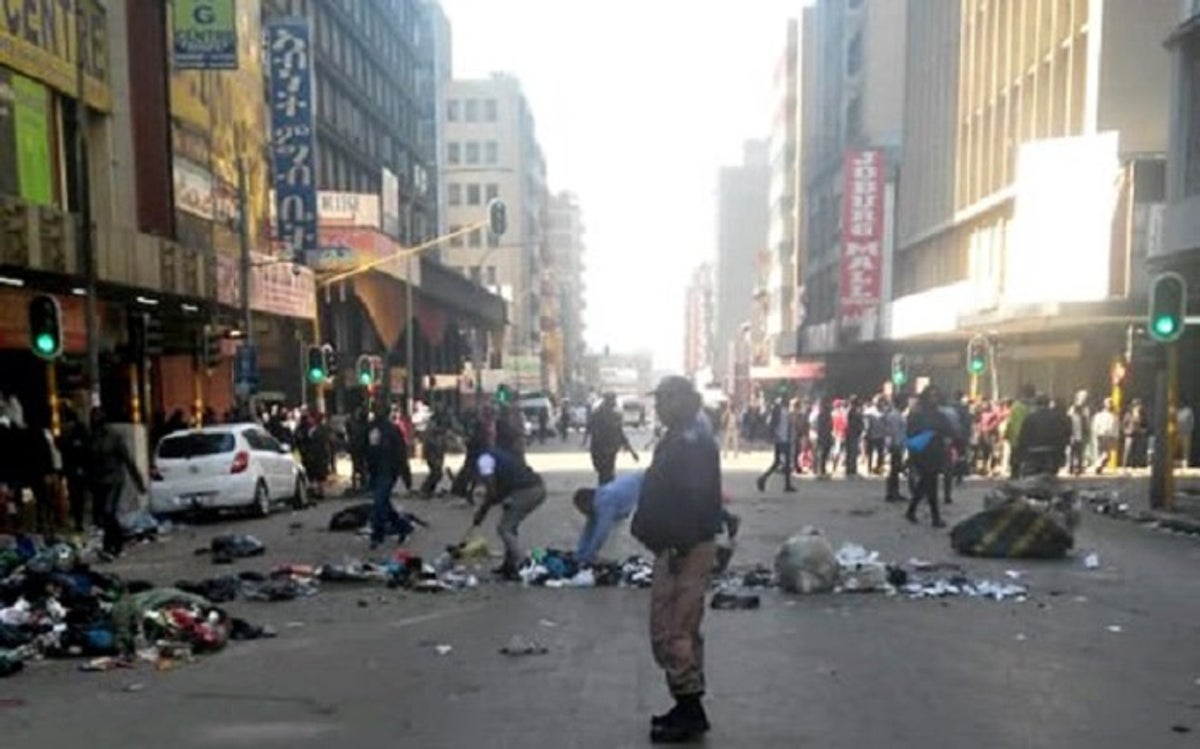
At the same time, about 60 kilometers away from the capital, the police clashed with informal business owners and vendors in the Johannesburg CBD. The stench of the wage protest in Pretoria was still hovering in the air when tempers were flaring up in the country’s economic hub. In the midst of simmering emotions, members of the SAPS and Johannesburg Metro Police Department (JMPD) were assailed on duty by a rowdy and belligerent mob in the CBD. Police vehicles were pelted with stones and other objects by a sizeable group of angry vendors, fighting back like wild cats guarding their territory jealously.
On that tumultuous day, the police had set out on a routine raid to confiscate counterfeit goods on the streets, sweatshops and trading stalls in downtown Jo’burg. Inadvertently, the law enforcers were met with violent resistance in the targeted frontier. When the raid turned ugly, the police knew immediately it was not a familiar standoff at play. They retreated. Revving up their “nyalas” with all their might, seeking refuge, they negotiated their way out of the turmoil.
A hail of harmful objects escorting the evasion could not impede police vehicles. The police had descended on the bustling city of Jo’burg to enforce the rule of law, they ran for the hills. A sight barely heard of, much less seen. The digital age comes pretty handy nowadays, onlookers readily provided streaming visuals of minute-to-minute account of the police fleeing the unruly scene and scurrying their duty vehicles. A very appalling spectacle.
Gauteng Police Commissioner Lieutenant-General Alias Mawela told Newz Room Africa that “tactical withdrawal” was one of the options the police had to avoid shooting many people. Had the rioters “surrounded the nyalas”, the police would have been left with no option but to shoot… And it was going to be a question of “counting many dead bodies” among the discussions.
Shirking responsibility
Eventually, the riot came to a halt. Peace was restored. Objects downed. Expletives hurled. Varying explanations came thick and fast. Which perspective to believe or doubt depended on who the storytellers were. As usual, the blame game began. Hawkers fingered the charging police that they were the ones at fault and had ulterior motives. The police fired back with their legal right to deal with illegal and counterfeit trade. An expat representing foreign nationals in the country was non-committal, but stopped short of implicating SA vendors. Speaking on SABC TV (channel 404 on DStv), City mayor Herman Mashaba placed the blame on the doorstep of the Department of Home Affairs and its failures to regulate immigration. And the story went.
Geo-politics
Mashaba zeroes in on the effects of illegal immigration. Can it be a war SA needs to confront forthright? Diplomacy has its place. Look at how United States of America (USA) is waging a gruelling war against China on trade based on, if they are to be believed, “tariffs” and currency devaluation. There is also a nuclear war between the USA and some countries like North Korea and Iran on who should produce or have access to uranium and other biological weapons.
In SA, the battle is on, inter alia, fake goods and cheap labour. Surely, where there is a scarcity of certain skills set, those can be sought beyond the borders. Therefore, hard-to-get skills which do not threaten the livelihoods of the locals should be welcomed. Brain-gain should not be confused with terror on the domestic labour force.
Thus, SA finds itself in the coalface of geo-political battles due to illegal immigrants, seeing it as a promising land with countless business, artistic and other opportunities. There are grounds to believe South Africans have not fully exploited available opportunities, hence foreign nationals capitalise on this uncharted market. Additionally, it will always be a challenge to monitor the influx of illegal immigrants resulting from political instability, poverty, and displacement brought to bear by hardships in their variance from country-to-country. Citizens are a fragile and mobile class. Economic strife and opportunities force foreign citizens to leave their countries. Some find SA a soft-landing. Regrettably, much to the chagrin of the natives.
Stinks like terrorism
It is when people have their backs against the wall that their instincts of urgency kick in. Africa finds itself in dire need of development. It has always been underdeveloped. The growing populations out of sync with economic growth rates complicates things. Some countries experience negative economic output, while others are punctuated by fluctuations – economic peaks and troughs. Where there is a marked economic upswing it is too little to absorb and offset the high unemployment rates among the people in Africa.
The people whose prospects are non-existent in their own countries have to trek and cross rivers and borders to seek pastures for survival. The southern tip of Africa offers a respite for opportunities, no matter how minute these may be. Hemmed on the southernmost sphere is SA. A good number of immigrants also look up north toward Europe to try their luck.
The Johannesburg police clash with illegal traders was characterised by what one of the observers called a “disgusting” development.
The identity of those faceless transgressors is still in question. However, a statement from the police later that day made it emphatically clear that they were foreign nationals. Hurling stones, bricks, petrol bombs and unidentifiable objects is never permissible regardless of nationality. Lawlessness by any perpetrator is prohibited in this country. Therefore, (elements of) criminality must not be countenanced.
In America and Europe, an attack by a foreign citizen(s) on national assets, even citizens, qualifies as terrorism. In SA, however, the (terrorism) label is scarcely used. Perhaps it has something to do with its rarity. Nevertheless, if there were locals among police attackers in the Johannesburg riots, then their behaviour amounts to vandalism. But the involvement of any foreign national fits the terrorism tag.
Bold solutions
Unless the authorities properly define and classify what really happened in Johannesburg, it will be merely impossible to ascertain how to mitigate the chances of its occurrence all over again. Its manifest seemingly showed it had been slowly building up until the eruption witnessed on Thursday last week.
No amount of sugar-coating can camouflage the gathering rage along nationality lines.
The tinderbox lead is up.
To reposition or reset it – the lead, brevity and conviction will be required. There is no other way around it than to confront this menacing powderkeg seeping in the cities and towns across the country. The face-off was not about trade policy, which on any given front it would require fair dealing with treaties and legal frameworks in place among nations. Failure to recognise them (the pacts or treaties) would render countries ungovernable – an untenable challenge that would expose future generations. Consequences will be dire.
Undeniably, illegal trade tide is screaming its devastating waves out for attention to flip it around in this country. The fact remains, not only will SA continue to be a safe haven for asylum seekers since 1994, but also it will stay a country teeming with business and other opportunities to eke out a living for expatriates, legal or otherwise.